|
Search Orders: |
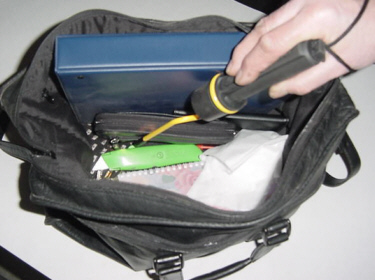
| A search order is often one of the first steps of any investigation, there are two main types of order, our investigators are extensively experienced in assisting with both. |
| Search Orders (Civil) |
|
A civil search order gives a solicitor the legal power to search the home or business premises of persons suspected to have committed an act which has resulted in litigation (legal action) against them. These orders are granted by a judge at a
civil Court, and each application for a search order has to be
accompanied by a package of evidence that the judge
considers and then makes a decision based upon the strength
of the evidence presented. Once an order is granted, the individuals named on the search order (such as solicitors and independent computer investigators) are legally allowed to enter the premises of the suspect and collect any relevant material (and computer data) that may contain evidence in relation to the investigation. During search orders it is common to encounter computer systems, Personal Digital Assistants (PDA's), External Hard Drives, USB Memory Sticks, Compact Discs, Blackberry's and Mobile Phones. All of which contain information that usually has to be forensically imaged (captured) on the premises (by a trained professional) and examined for relevancy at a later date. Unless circumstances dictate, it is uncommon for an item to be removed from the search order premises. |
| Search & Seize Orders (Criminal) |
|
Police search and seize orders are very
similar to Civil orders, however, any material removed from
the premises has to be 'seized' by a Police Officer and
handled in a particular manner to ensure that evidential
continuity (correct procedure) is followed. Key techniques employed by the Police are applied by our investigators during the aforementioned civil search orders, to ensure that should a civil matter develop into a criminal matter, any evidence collected is admissible in a court of law. Criminal search and seize orders involve all evidence being physically removed from the premises and examined on Police premises at a later date. In exceptional cases, where computer equipment is used to operate a business, forensic imaging of any computer equipment takes place. It is all too common for evidence produced as a result of an investigation, to be rejected by the court on the grounds that it was not collected at source in accordance with evidence handling procedures that form part of the Criminal Justice Act.
|
| Delivery Up Orders (Civil) |
|
A delivery up order is granted by a civil
court and effectively 'orders' an individual to surrender
property or information that is believed to be evidence in
the investigation the order forms part of. The most common targets for this type of court order are computers (both desktop and laptop) and paper documents. The respondent (recipient) of a delivery up order usually has a finite period of time to surrender the material he/she has been ordered to 'deliver up' by the court. Delivery is usually made to the claimant's (the person who initiated the investigation) legal representative, or directly to a third party (such as ourselves) for analysis purposes. Delivery up orders are often used as an alternative, or a precursor, to a costly search order. |